Yorkshire Dales Dialect

Local Dialect

Nidderdale was part of the old West Riding of Yorkshire, however, you may find our local dialect has more in common with the traditional North Riding. Most Yorkshire accents you’ll hear on TV are modern day West and South Yorkshire e.g. Leeds and Sheffield, and these are actually quite different to the dialect traditionally spoken in the Dales. For example you might hear “reyt” for “right”, or “rahnd” for “round” in West Yorkshire today, but you’re more likely to hear “reet” and “roond” in the Dales.

Upper Nidderdale is right on the border with the old North Riding, which may provide a partial explanation for the influence, particularly as trade and family ties routinely crossed the border. Whilst the industrial revolution saw an influx of people into manufacturing towns such as Leeds and Bradford, giving them their own distinct dialect and accents, rural areas of the Dales remained relatively isolated and less influenced by outside changes.
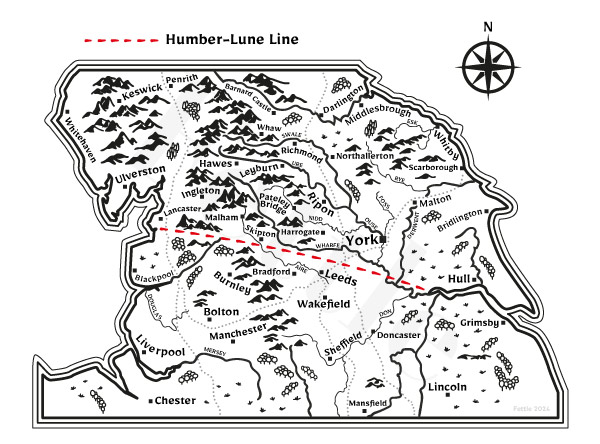
Nidderdale sits firmly above the “Humber-Lune” line, which is an isophone drawn diagonally across the North of England. To quote The Yorkshire Dialect Society:

“Strictly speaking, the dialects spoken south and west of this isophone are Midland dialects, whereas the dialects spoken north and east of it are truly Northern.”

This is one reason why you might notice similiarities between North Riding Yorkshire, Cumbrian, and Scots dialect and accents e.g. “coo” for cow, “hoose” for house, “steean” for stone, quite different to the dialect of West and South Yorkshire. There also tends to be more Scandinavian influence remaining in dialects above the line too.

Map of the Humber-Lune line

The Humber-Lune Line

Although many dialects have become “flattened” by exposure to other accents via film and television, a recognisably Dales dialect remains, particularly among older speakers and farming families. Many agricultural terms trace their roots back to Old English and Old Norse. Some words are basically unchanged such as “gimmer”, meaning a female lamb, which comes directly from Old Norse.

Audio Example

Back in 1952, a recording was made of a lady from Pateley Bridge, interviewed as part of a survey of English dialects. Listen here and see if you can follow along as she describes her method for baking bread. You’ll hear words you might be unfamiliar with such as “yewn” for oven. If you’re familiar with Cumbrian dialect, you’ll notice many similarities. There’s a free bread recipe in it for you if you can understand her!

A handful of dialect words:

Abunn = above
Aginn = against (leaning against, next to)
Allus = always
Backend = autumn
Band = string*
Beck = stream
Bleb = blister
Een = eyes
Ginnel = alleyway
Glishy = bright/sunny
Lahl = little
Lop = flea
Mowdy/mowdywarp = mole (animal)
Mun = must

* baler band is practically the 4th emergency service on a farm.

Nithered = cold
Nowt = nothing
Owt = anything
Ower = over
Slape – slippery or smooth
Sneck = gate/door latch
Stoop = gate post
Teeafit = lapwing
Tup = ram
Wick = alive/lively
Yam = home
Yan = one
Yonder = over there
Yow = ewe

Pronunciation

Pronunciation of vowels can be quite different to standard English, e.g. you’ll often hear a short “i” sound, so “find” becomes “finnd”, “blind” becomes “blinnd”. Similarly, the vowel sound in “pound” becomes “pund”, “ground” becomes “grund”.

We say “neet” for night”, “deed” for “died”, “coo” for “cow”. A word like “door” is pronounced “dooar”, “sweat” becomes “sweeat”, “forty” becomes “fotty”, “awkward” becomes “okkad”, “broken” becomes “brokken”. Words like “tumble” and “grumble” become “tummel” and “grummel”.

We often drop “h” completely, so “horse” becomes “oss”, “however” becomes “owivver”. We drop whole words such as “the” and use a glottal stop, which is often represented by an apostrophe. So instead of saying “going to the shop” it becomes “going t’ shop”. This is the one feature people try to emulate when doing a jokey Yorkshire accent, and almost inevitably put the glottal stops in the wrong place. It’s a dead giveaway to a native speaker.

Other interesting features

We don’t always use plurals, particularly with measurements. So instead of saying “twenty miles away” we say “twenty mile away”, or “two inch” instead of “two inches”, “four foot” instead of “four feet”. Also applies to time, e.g. “three week sin” instead of “three weeks since”, or “five hour ago”.

Thee, thy, and thou are still used. Pronunciation may differ though, e.g. “thissen” means “yourself”, “thoo” (or “tha/ta”) means “you”. For example, the phrase “dost tha ken yon lass?” means “do you know that girl/woman?”, and “weears ta gannin til?” means “where are you going (to)?”

There’s a lot more to learn, and it gets pretty technical if you’re really serious about it. If you’re interested in finding out more, visit The Yorkshire Dialect Society’s website and The Dialect and Heritage Project.